Introducing Lightfield for Enterprise and our contract buy-out program

Keith Peiris
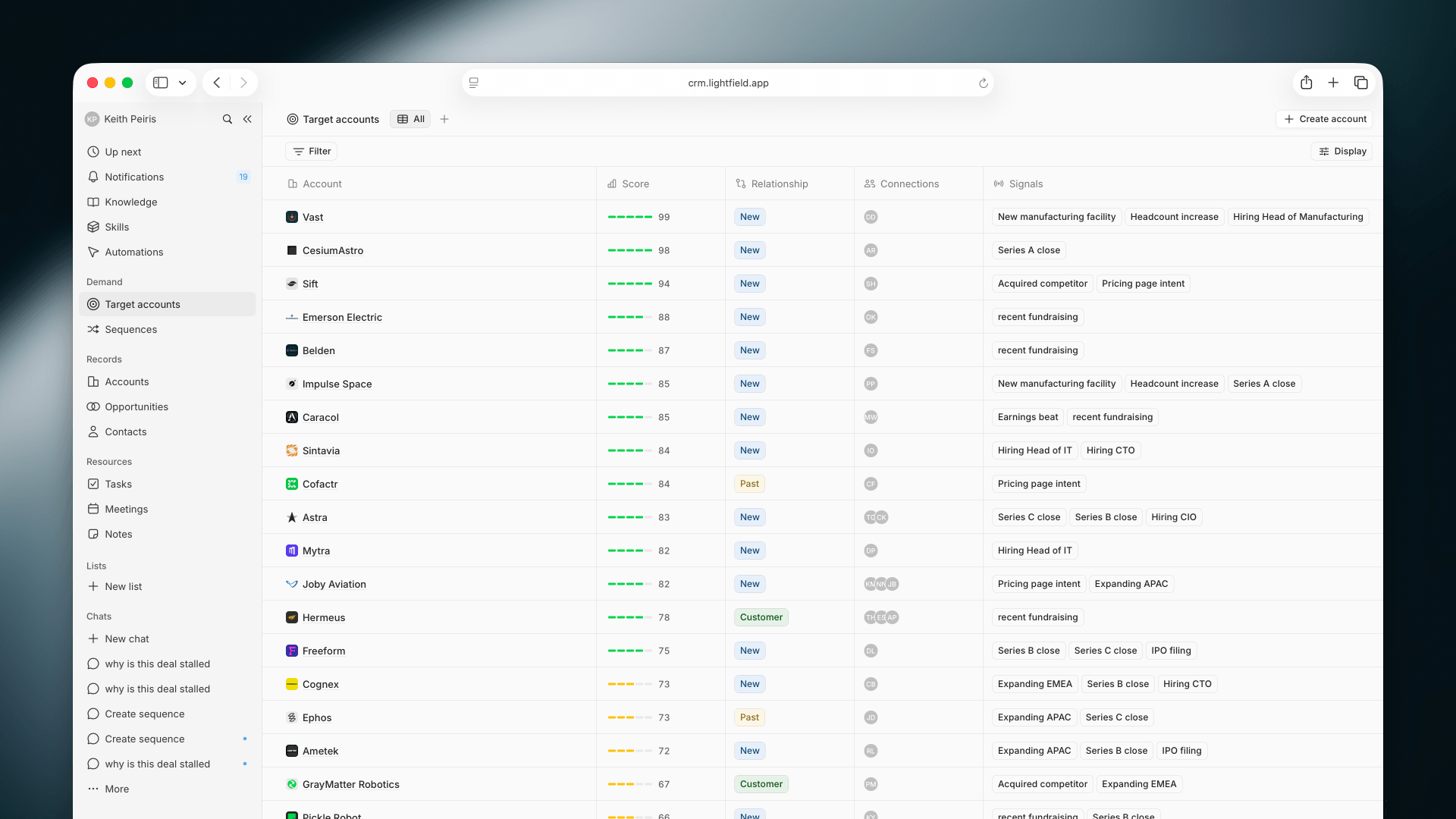
Today we’re launching Lightfield for Enterprise. We’ll buy out your Salesforce or Hubspot contract, migrate you over in 30 days or less, and won’t charge you until your implementation is finished.
One year ago we launched Lightfield with the goal of building a CRM that any sales team can run on, whether that’s a two-person startup or a multinational sales org.
Since then, we’ve migrated thousands of companies off legacy CRM. Some of our customers, like Albert Invent and Intent HQ, have hundreds of users working together in Lightfield on long, complex sales cycles. We forward-deployed engineers into companies like these and built whatever they needed to run their entire sales org on Lightfield. Lightfield for Enterprise packages that work into a product any company can buy today.
Frontier intelligence with enterprise controls
Lightfield captures first party (email, meeting, call) and third party (Slack, Granola, Notion) information and adds it to your data model, giving agents a full history to work from. Enterprise adds what a larger sales org needs on top of that: the ability to handle hundreds of thousands of deals, controls over who sees what, and integrations to the rest of the company's systems.
Customization
As a sales org grows, its CRM has more records to analyze and more people working in it. Internally, the team splits into specialized roles, such as AEs, engagement managers, and solutions leads, organized into teams with their own reporting lines. Externally, the business it has to model gets more complex: customers with dozens of subsidiaries, separate motions for new business, expansion, and renewals, as well as entities that don't fit a standard CRM object.
With Lightfield, you can model your market the way it actually works instead of force-fitting the complexities of your business into out-of-the-box objects and fields. You can configure custom objects and relationships that reflect the nuances of your business, including parent-child relationships across objects. Each object can be customized with a broad set of fields, including formula and conditional fields, to accurately reflect your business. Pipelines can be configured from any object in the CRM, each with their own stages and exit criteria.
Lightfield can also model how your team is organized. A record can have several people in different roles. Admins can set the default view each team sees, and can change how a page looks for a role by describing it to the agent, which builds the page from tables, tiles, and summaries.
Control
Lightfield provides admins with rigorous controls to dictate which users can access which types of data, and what permissions different users have to view or edit different records or fields within the CRM.
To start, Lightfield supports SAML or OIDC single sign-on per domain, SCIM provisioning and offboarding, and enforced MFA. Admins can review and revoke sessions.
Admins can configure roles and groups that determine what users can see and edit, per object and per record. Groups set what users can see and edit, per object and per record. API keys are scoped by object and action. Agents, automations, and API keys work with the same permissions as the person they act for.
Validation rules and stage requirements decide what can change, and they block an agent's update the same way they block a rep's. Each AI-filled field can be set to Off, Suggest, or Auto, customer-facing drafts wait for a named reviewer, and every change on a record shows whether a person, an automation, or Lightfield made it.
Compliance
Admins and users decide what enters the CRM. Admins keep a workspace Do-not-track list of blocked senders and domains, and choose how far back to sync, between 1 and 24 months. Internal-only meetings are excluded by default. Email and meetings are private by default, and private items never enter AI context. An executive who wants customer conversations synced but HR and legal conversations kept out can describe those exclusions in plain English, and the categories are visible only to the mailbox owner.
Every record has an activity log that shows whether a person, an Automation, or Lightfield made each change. Automation runs keep a versioned history. Custom fields keep their value history, deleted records go to Trash, and you can restore to a point in time.
Lightfield has SOC 2 Type II and a GDPR DPA. We sign BAAs for businesses with HIPAA compliant requirements. ISO 27001 is in progress. Data is encrypted at rest and in transit. We don’t train or fine-tune foundation models on customer data.
Integration
At a larger company CRM sits among many other systems: call recorders, a data warehouse, billing, marketing automation, the old CRM during a migration, and the company's own agents. Its CRM has to bring in what happens across those tools, let other systems and agents read and write to it, run alongside the old CRM while teams move, and reach the systems nobody has built a connector for. Lightfield is an open platform: anything our agent can do, other systems and agents can do too, and you can export everything at any time.
Activity comes in from wherever your team works. Lightfield captures Gmail, Outlook, calendars, and shared inboxes, records meetings including Microsoft Teams, and syncs Slack, LinkedIn, WhatsApp, Gong, and Granola.
Lightfield is a headless CRM. Everything you can do in the app, you can do through the REST API, the MCP server, or the CLI, and the same access rules apply in all of them. Keys are scoped by object and action, reads respect the caller's permissions, and Claude, ChatGPT, or your own agents work from the same records and rules as ours. We don’t charge fees to read your own data, and you can export any view, or everything, at any time.
For systems with no native connector, admins store API keys as workspace secrets. Lightfield adds the key on the server and sends it only to the domain it belongs to, so the model never sees it. Our forward-deployed engineer can build a connector fo you. Or you can use webhooks for Lightfield to read and act on records from other systems.
During migration, two-way sync keeps Salesforce current. Salesforce changes sync to Lightfield on a schedule, Lightfield changes write back immediately, records keep their Salesforce IDs, and Lightfield never deletes anything in Salesforce.
Migrate in 30 days
Moving a large sales org off Salesforce or HubSpot used to be challenging for three reasons. Years of configuration have to be rebuilt. Every record has to arrive intact, with its owner and history. And the team can’t stop selling while it happens. That’s why these migrations are usually measured in quarters and handed to an implementation partner.
We do them in 30 days, and average 6 days from kickoff until AEs are selling inside Lightfield.
Every Enterprise customer gets a Delivery Strategist, a Forward Deployed Engineer, and a Customer Success Manager to guide you through the migration. Our migration agent proposes your data model from an export, then imports and reconciles every record back to your old CRM, which frees the team for the harder work. Workflows, permissions, and reports are rebuilt to parity with how you work today. Your FDE builds any integration we don’t already support, in two weeks on average, working directly with your IT team.
We plan the cutover backward from the day your current contract ends, move a pilot group first so the rest of the team keeps selling, and review results against success criteria agreed before kickoff. You don’t pay us until the migration is complete.
Our contract buy-out program
One of the greatest ironies I’ve observed over the past year is that the companies who would benefit most from Lightfield tend to be the least likely to think they can switch. They switch to (or stick with) Salesforce because they think it’s the only viable CRM for a large scaling team.
That may have been true in the past, but it’s not anymore.
Our most successful customers are the ones who came to us with the most complex requirements. We’re proud of the work we’ve done with our early adopters, and are excited to start scaling out what we’ve built across more companies.
A contract shouldn’t be what keeps you from switching. When you sign with Lightfield, we credit the months left on your Salesforce or HubSpot contract against your Lightfield contract, our team runs the migration for you, and you don’t pay us until the implementation is complete.
Our goal is that by the end of the next year, Lightfield will be the industry standard for CRM at AI-native companies.